
Prove it neither disturbs nor is disturbed — to MIL-STD-461.
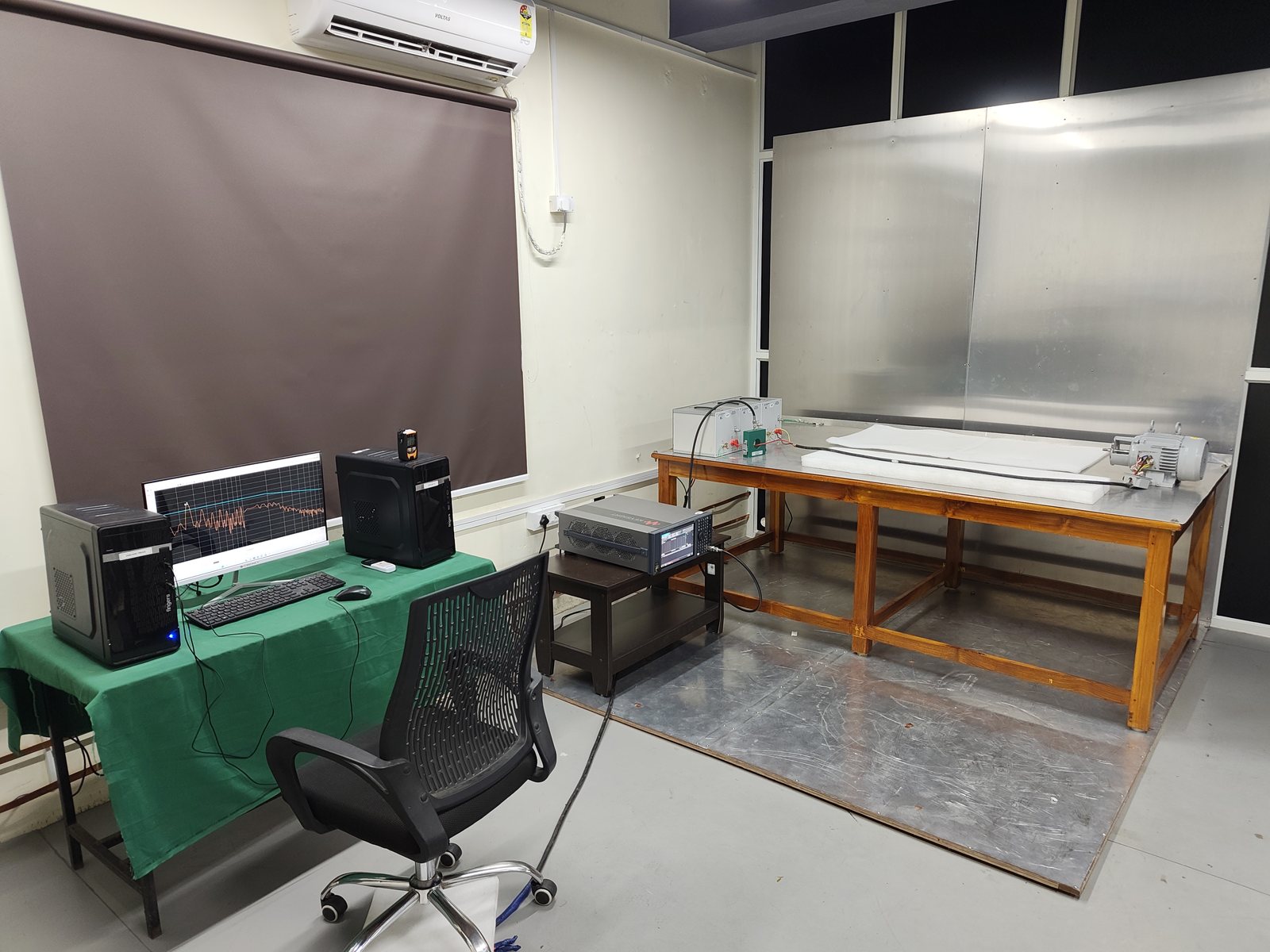
Our own 8 × 6 × 4.5 m shielded chamber, with a door big enough for a full cabinet — to prove your equipment doesn't disturb anything around it, and keeps working when everything around it is noisy.
What customers bring us
Full CE/CS/RE/RS suite on a power-conversion unit to MIL-STD-461G
CS114 / CS115 / CS116 susceptibility of a communications controller
Pre-compliance sweeps during development, then the accredited run
What we run it on
- Semi-anechoic chamber, 8.0 × 6.0 × 4.5 m shield-to-shield, shielding validated 9 kHz – 40 GHz to IEEE-299; 3.0 × 3.0 m pneumatic RF door, 4-tonne floor, 150 mm reflective ground plane
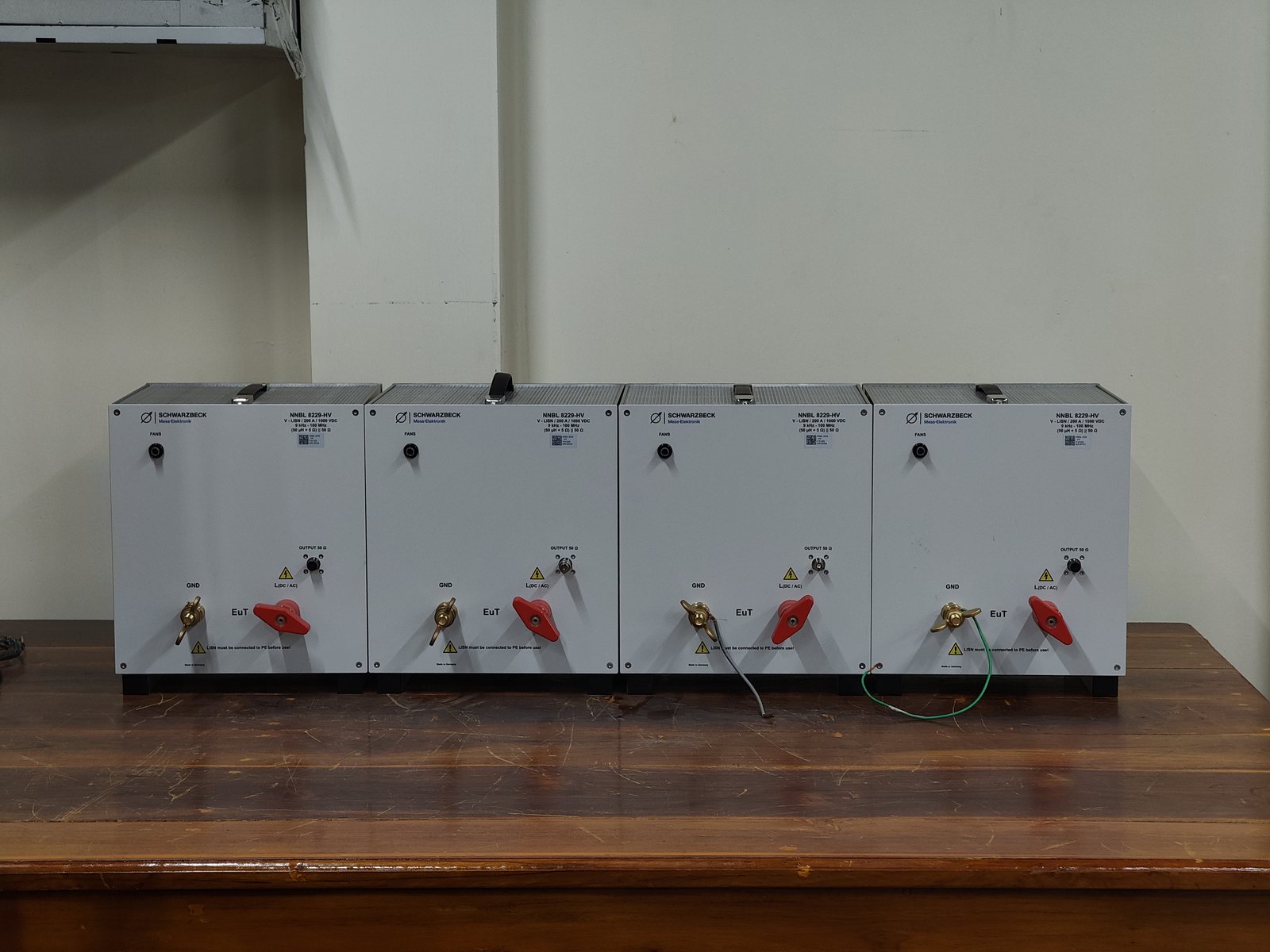
- RE102 at 1 m, 10 kHz – 18 GHz — Keysight 26.5 GHz EMI receiver, active monopole, biconical and horn antennas, single- and three-phase LISNs
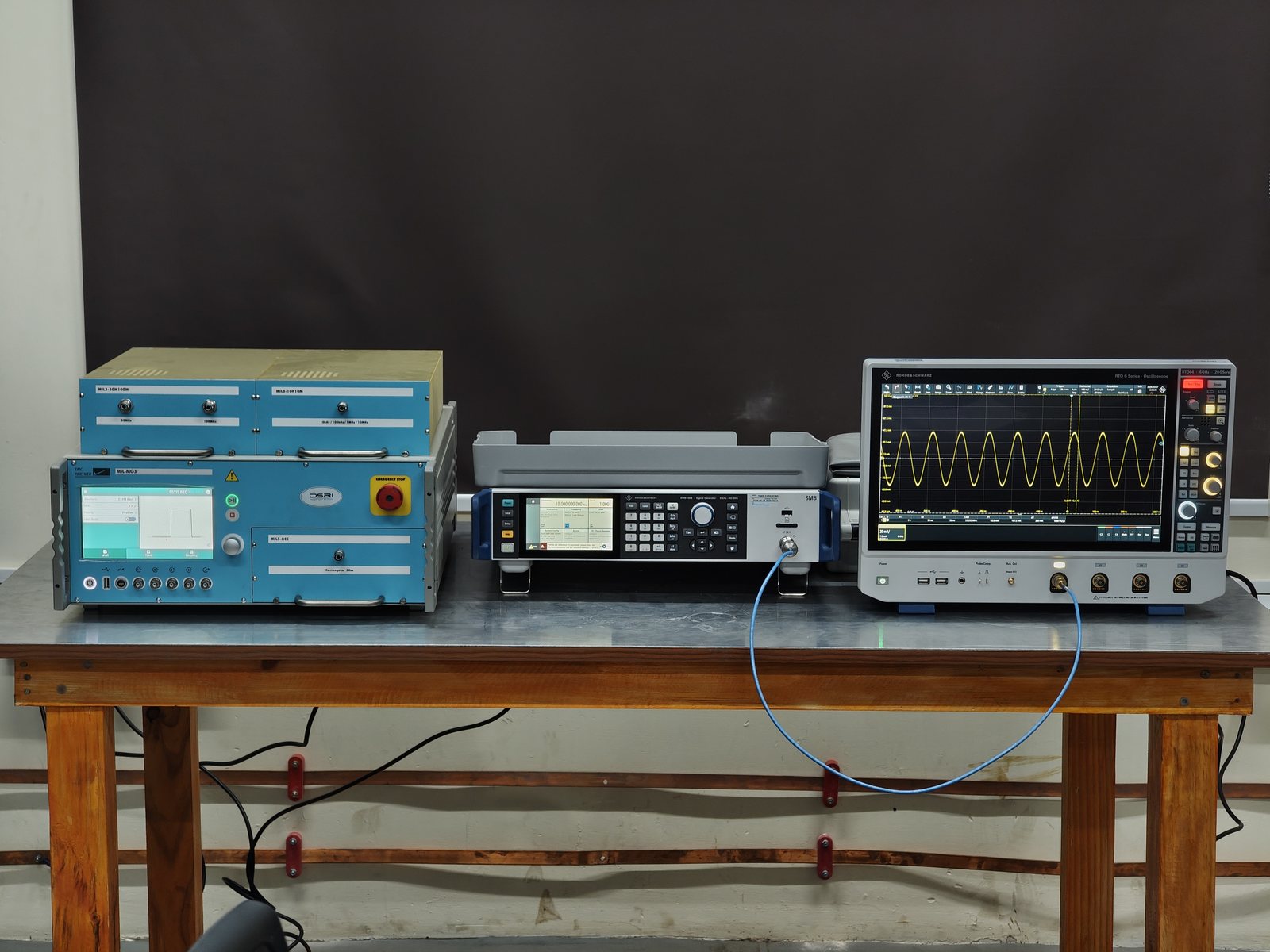
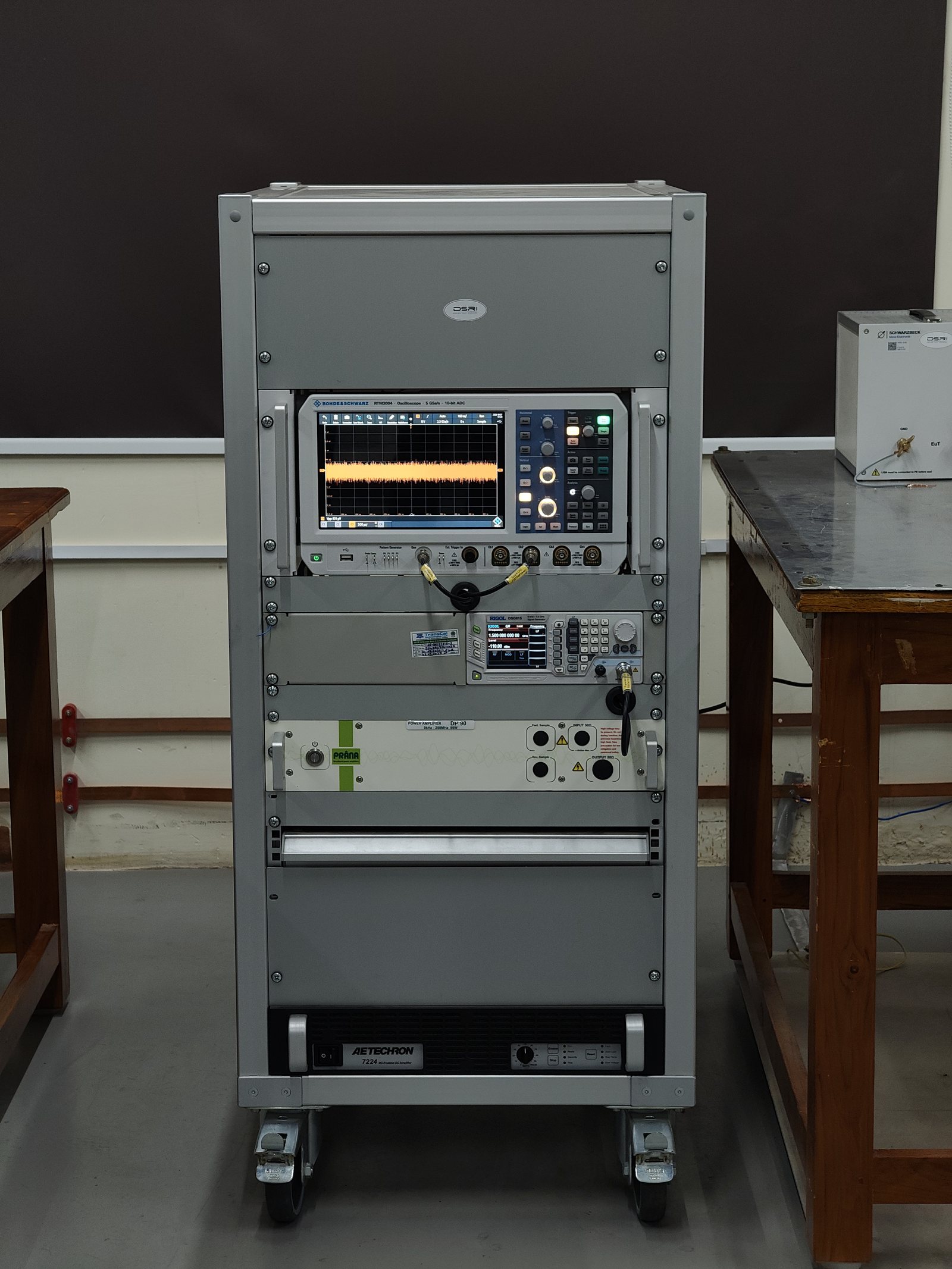
- RS103 at 1 m, 2 MHz – 18 GHz, guaranteed 50 V/m — 1,300 W / 250 W / 100 W / 50 W amplifier chain, R&S SMB100B source, PMM EPP603 field probe
- Current probes and injection equipment for the CS114 / CS115 / CS116 suite; NEXIO BAT automation for emissions and susceptibility
Engineering alongside
Pre-test analysis, fixture design and correlation are available for every job in this lab — so a marginal design is caught in the model, not on the machine.
Engineering →Which test answers your question?
EMC is two questions: does your equipment disturb anything else, and does anything else disturb it? Start with the one your specification asks. Cards show which tests are NABL accredited. Engineers: methods, standards and reported properties are in the standards & methods reference.
Does it disturb anything?
Is it putting noise back onto the power supply?
Everything that switches power makes electrical noise, and it travels back along the power cables to other equipment. We measure it against the limit.
You get- Pass or fail against the limit
- How close it came, and where
Is its magnetic field disturbing things close by?
Transformers and motors give off magnetic fields that upset sensitive equipment nearby. We scan every face of your unit for them.
You get- Pass or fail against the limit
- Where the field was strongest
Is it broadcasting radio noise?
Electronics leak radio-frequency noise that can jam radios and radars on the same platform. We measure it in our shielded chamber.
You get- Pass or fail against the limit
- How close it came, and where
Does anything disturb it?
Does it keep working when its cables pick up interference?
Cables act as aerials. We inject the interference they would pick up on a real platform and watch whether your unit misbehaves.
You get- Pass or fail against your criteria
- What upset it, and at what level, if anything did
Does a strong magnetic field upset it?
Near big motors, transformers and power cables, magnetic fields are strong. We apply them to every face of your unit.
You get- Pass or fail against your criteria
- What upset it, if anything did
Does it keep working next to a radio transmitter?
Ships, aircraft and vehicles are full of transmitters. We bathe your unit in strong radio fields in our chamber and watch how it behaves.
You get- Pass or fail against your criteria
- What upset it, if anything did
Can it take a static shock from someone touching it?
People carry static, and a spark from a fingertip can reset or damage electronics. We zap every point an operator can touch.
You get- Pass or fail against your criteria
- Which points, if any, caused a problem
Platform EMC
Does it meet the platform's EMC rules?
Ships, aircraft and vehicles have EMC rules for the whole platform, not just each box. We run the equipment-level tests your platform programme calls up.
You get- Results against your platform specification
Technical detail for engineers — methods, standards, reported properties →
From specimen to signed report
Test plan
We agree which tests, which limits, the unit's operating modes and — for susceptibility — how you'll tell whether it has been upset.
Set-up
Your unit goes on the ground-plane test table with its cables laid out as the standard requires, and we check the chamber's background is quiet enough.
Emissions
We measure what your unit gives off, in each operating mode, against the limits.
Susceptibility
We apply each disturbance while your unit runs and is monitored. Progress photos appear in your customer portal.
Report
Plots against limits and results against your pass / fail criteria — under the NABL symbol where the method is accredited.
What to send for a quotation
- The unit: size, mass, power supply (voltage, phases, current) and its cables and interfaces
- The standard and revision, the tests and the limits — or the platform specification that sets them
- How the unit is exercised and monitored during the test, and what counts as a failure
- Support equipment you'll bring, and anything that must stay outside the chamber
- How many units
For engineers: the full method table, standards and equipment ranges for this lab are under For engineers → Methods & standards and Equipment & ranges.
Questions we get about emi / emc work
Can we witness the test?
Yes. Tell us at enquiry and we'll book a witness slot. Third-party inspectors are welcome too — RITES, Lloyd's Register, CQAE, IRS, ABS, RINA and other agencies witness tests here.
Will our unit fit?
Very likely. The chamber is 8 × 6 × 4.5 m inside, with a 3 × 3 m door and a floor rated for 4 tonnes, so a full cabinet or skid goes straight in.
Can you help before the formal test?
Yes. Pre-compliance sweeps during development show where the problems are while they're still cheap to fix; the formal run follows when you're ready.
Which EMC tests are accredited?
MIL-STD-461 CE101, CE102, CS101, CS109, CS114, CS115, CS116, CS118, RE101 and RS101 are in our NABL scope. RE102 and RS103 run in the same chamber and are reported without the NABL symbol until the scope is extended.
Do you test to commercial EMC standards?
Not yet — our EMC work today is MIL-STD-461, plus MIL-STD-464 platform support. Commercial emissions and immunity (CISPR and IEC 61000) are planned; ask us if you need them and we'll tell you when.
How long does it take?
We reply to enquiries within one working day. A full MIL-STD-461 suite typically takes one to two weeks in the chamber, and the report follows within 2–3 working days of the test. When we can start depends on chamber availability, which we confirm with the quotation.
Why are some tests accredited and some not?
Our accredited methods are the ones customers ask for most, so we keep them under regular NABL assessment and report them under the NABL symbol. Non-accredited work is usually a custom, rare or specialised method — or one we develop for your problem — reported without the NABL symbol.
Ready to quote emi / emc work?
Send the standard, the profile and the unit size — we'll confirm the machine and the schedule.