
Where testing meets design
Five verticals that sit between the standard test list and the analysis desk — the problems that come up when equipment has to be isolated, mounted, held and understood, not just exposed to an environment. Each combines our machines with measurement and engineering judgement.
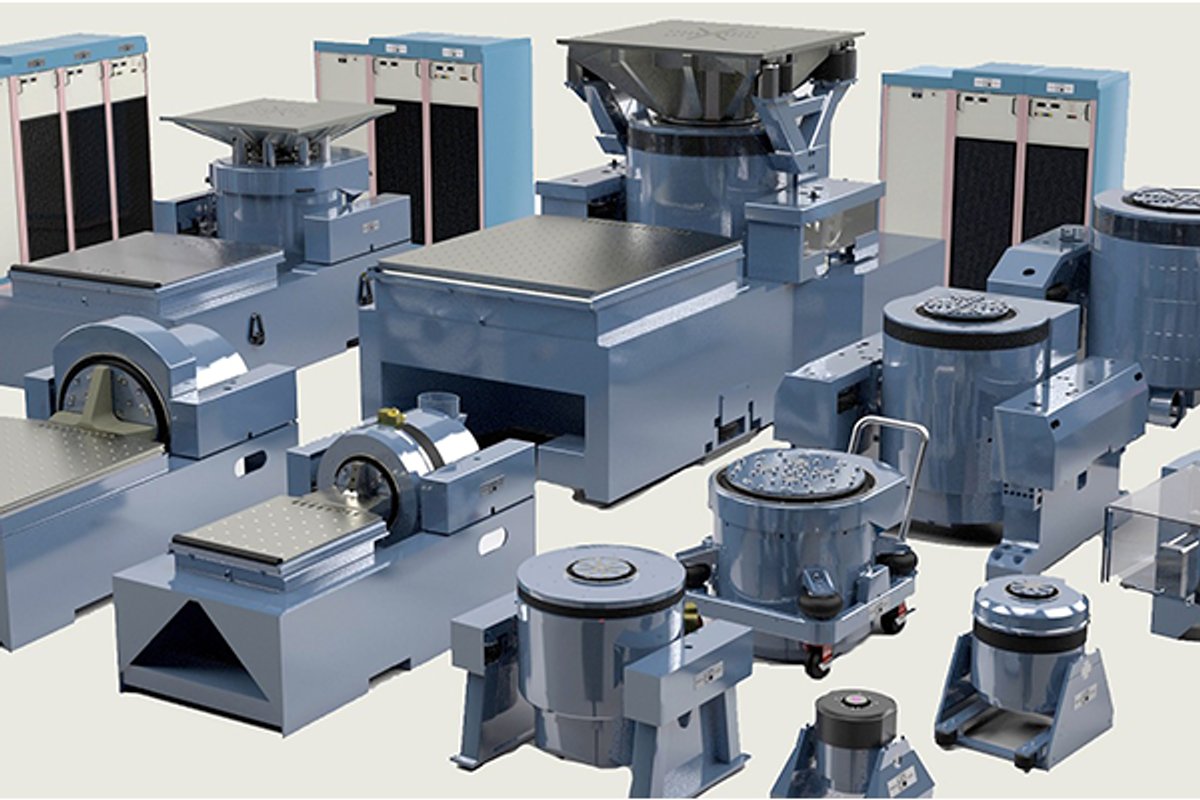
Resilient mount & isolator testing
Dynamic transfer stiffness and vibro-acoustic transfer properties of resilient elements — engine mounts, machinery rafts, shock mounts, pipe hangers, resilient bearings — measured under representative static preload, as naval and industrial specifications require.
- ISO 10846 Parts 1–5: direct method (Part 2) on the 250 kN biaxial machine with dynamic preload; indirect method (Part 3) with a blocking mass; point and transfer stiffness; translational and rotational.
- ISO 18437 Parts 1–5: dynamic mechanical properties of visco-elastic materials — resonance, non-resonance and impedance methods, temperature–frequency superposition.
- Static load–deflection, creep and set; low-temperature and salt-fog conditioned mounts on request.
- Output: transfer-stiffness spectra, loss factor, insertion loss — in the format your acoustic model needs.
Typical customers
Shipyards and naval establishments qualifying machinery mounts against structure-borne-noise budgets; OEMs characterising isolators for MIL-STD-740 / NES 1004 compliance; railway and industrial suppliers.
Discuss a mount programmeDeliverables
- Dynamic stiffness and mass requirements for the foundation
- Mount selection and layout with predicted transmissibility
- Natural-frequency separation from excitation orders
- Drawings, FE model and a measurement plan to verify on installation
Foundation design
A foundation is the last isolator in the chain. We design and analyse rafts, seatings and bedplates for rotating machinery, test rigs and shipboard equipment so that mount performance measured in the lab is realised on site: stiffness targets, modal separation, alignment and shock survivability.
Where the installation exists, we measure it — mobility at the mount feet, operating deflection shapes, transmissibility — and feed the numbers back into the design.
Fixture design
The fixture is part of the test. A bad one adds resonances inside the test band, over-tests one axis and under-tests another. We design, analyse, fabricate and qualify fixtures for our shakers (to 16,000 kgf), shock and bump machines, the centrifuge and the ship-motion simulator, and chambers where thermal mass or airflow matters.
- FE analysis for first-mode target (typically > 1.5–2× the upper test frequency) and transmissibility across the table
- Material and joint selection: magnesium, aluminium, steel; bolted vs welded; head-expander and slip-table interfaces
- Bare-fixture FRF survey and multi-point control strategy documented in the test plan
- Reusable fixture library for standard rack, box and bracket form factors
Also
Customer-supplied fixtures are surveyed before use, and the survey goes into the report. Fixtures can be stored for repeat programmes.
Send drawings for a fixtureMethods
- Impact-hammer and shaker-excited FRF surveys (SIMO / MIMO)
- Operational modal analysis on running machinery
- Mode shapes, damping, MAC against FE models
- Operating deflection shapes and order tracking
Modal testing
Measured natural frequencies, mode shapes and damping for structures from PCB brackets to machinery rafts and hull sections — to validate an FE model, to explain a vibration failure, or to prove that a design change moved a mode where it was meant to go.
Multi-channel acquisition with roving hammer or roving accelerometers, shaker excitation on the small and large shakers, and our in-house DSP toolkit for FRF, coherence and curve-fitting. Results are delivered with model correlation when an FE model exists.
Impedance & mobility measurement
Driving-point and transfer impedance (and its inverse, mobility) at machine feet, mount interfaces and structure attachment points — the inputs that structure-borne-noise prediction, source characterisation and mount selection all depend on.
- Point and transfer mobility to ISO 7626 methods, impact and shaker excitation
- Blocked-force and free-velocity source characterisation for machinery
- Transmissibility and insertion-loss measurement of installed isolation systems
- Feeds directly into ISO 10846 indirect-method testing and SBN budgeting against MIL-STD-740 / NES 1004
Combined programmes
Most customers combine these: characterise the mount (ISO 10846), measure the foundation mobility, predict the installed SBN, then verify it with an ABN/SBN survey. One team, one report.
Discuss a programmeBetween the test and the design
Tell us the problem — a noisy installation, a mount to qualify, a fixture to build — and we'll propose the measurement and the analysis together.